
Sattva Springs vs Casagrand Moondance Kumbalgodu
Sattva Springs is a low-density gated enclave of large 4 BHK row villas on Kanakapura Road at Kagalipura, near the Art of Living campus, by Sattva Group, with marquee villas from about 3,600 sqft, smaller layouts down to a 1,352 sqft 2 BHK, and pricing from about Rs 2 Crore. This page sets it against Casagrand Moondance Kumbalgodu - an 8.6-acre, 504-home low-rise apartment community off Mysore Road, from Rs 75 Lakhs at a Rs 5,399/sqft offer rate. These are not really substitutes but answers to two different questions: an exclusive, ground-touch villa with a private terrace versus an affordable, amenity-rich branded flat. Here is how the two read from the Sattva Springs side on location, configuration, price, built form, amenities and developer pedigree.
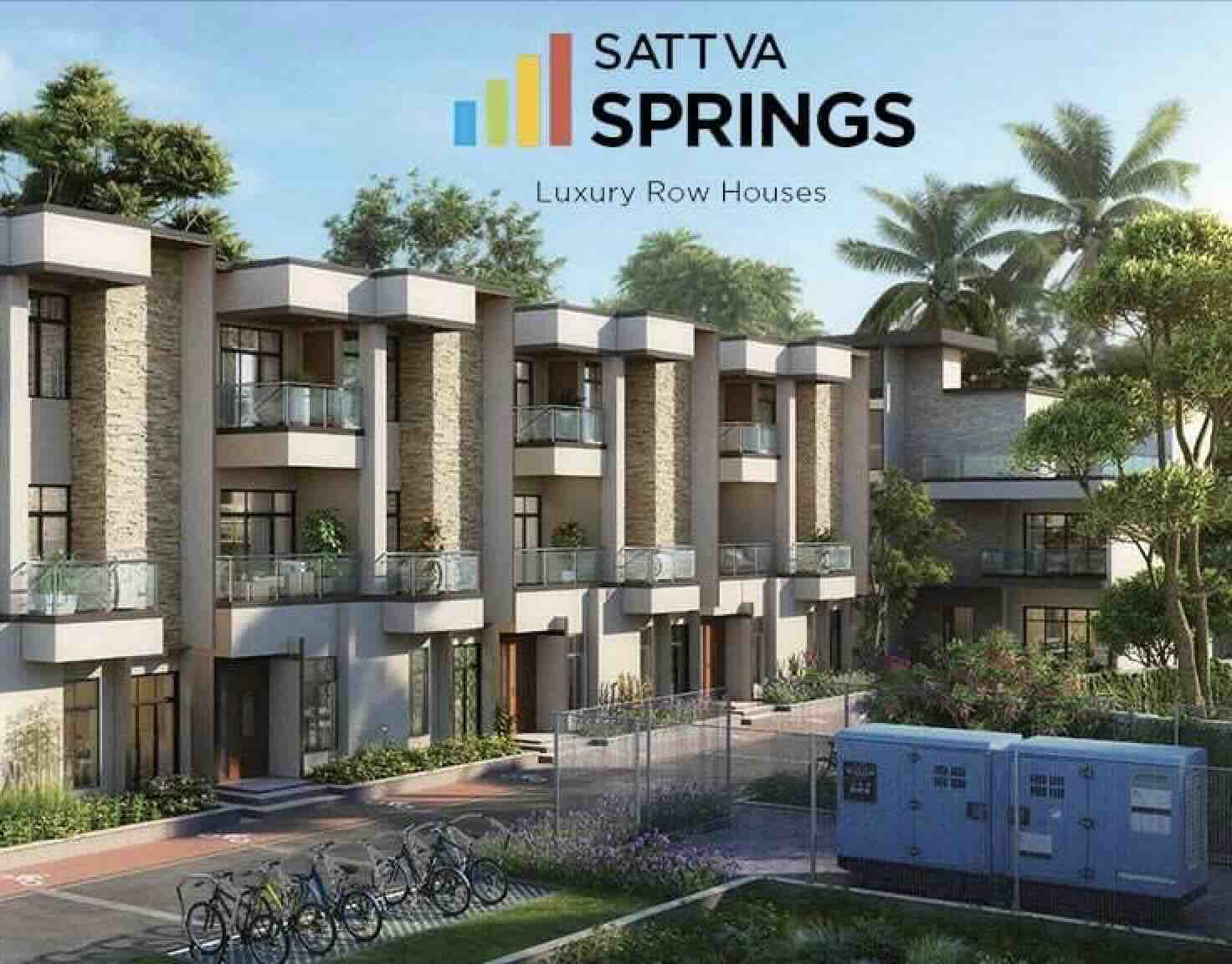
At a glance: Sattva Springs vs Casagrand Moondance Kumbalgodu
| Factor | Sattva Springs | Casagrand Moondance |
|---|---|---|
| Locality | Kagalipura, Kanakapura Road | Kumbalgodu, off Mysore Road |
| Land area | Low-density villa parcel | 8.6 acres |
| Units | Boutique villa enclave | 504 apartments |
| Built form | 4 BHK row villas | Low-rise B+G+4 |
| Configurations | 4 BHK villas (plus 2-3.5 BHK) | 2 & 3 BHK |
| Sizes | 1,352 - 5,236 sqft | 1,171 - 1,866 sqft |
| Entry price | From about Rs 2 Crore | From Rs 75 Lakhs |
| Base rate | Not published | Rs 5,399/sqft (offer) |
| Developer | Sattva Group | Casagrand |
| RERA | PRM/KA/RERA/1251/310/PR/240724/006948 | PRM/KA/RERA/1251/310/PR/200526/008667 |
Location and connectivity: the Kanakapura Road green belt
Sattva Springs sits on Kanakapura Road at Kagalipura, near the Art of Living campus, on the southern spine that runs out toward the greener, lower-density edge of the city. Per the project's own material, the nearest metro station is roughly ten minutes away and NICE Road provides fast access toward Electronic City, so the address taps the southern employment belt while staying on a calmer, less commercial stretch than the corridor closer to the city core. That calm is part of the point for a villa product - low traffic, more open surroundings and the kind of settled, leafy character that suits ground-touch homes rather than dense apartment stock.
Casagrand Moondance is on a different southern arm. It sits off Mysore Road (NH-275) at Kumbalgodu in the south-west, near the NICE Road interchange, leaning on the NICE Ring Road for a roughly 35-40 minute off-peak run to Electronic City and on the Purple Line metro extension along Mysore Road over time. Both ultimately reach the same southern job belt from different directions, so for a buyer choosing on location alone it comes down to which corridor your work and family ties favour. For a Sattva Springs shortlister, the relevant read is that the Kanakapura green belt is the natural fit for a low-density villa lifestyle, while Kumbalgodu is an outer Mysore Road apartment address that trades a slightly different commute for a far lower ticket. To weigh the alternative corridor, see how Casagrand frames its Kumbalgodu location against your own routine.
Configurations and sizing: large triplex villas versus compact flats
The configuration gap here is about product type, not just size. Sattva Springs is built around the 4 BHK row villa, laid out as a basement plus ground plus upper floors with private parking below and a private terrace on top. The headline villas run from about 3,600 to 5,236 sqft, and the project also references smaller layouts - a 2 BHK around 1,352 sqft, a 3 BHK near 2,003 sqft and a 3.5 BHK close to 2,975 sqft - though the marquee product most buyers come for is the triplex villa. A villa gives you vertical separation across your own floors, a private terrace and ground-touch entry that no stacked flat can replicate.
Casagrand Moondance is the opposite proposition: stacked apartments in two tight formats - 2 BHK from 1,171 to 1,470 sqft and 3 BHK from 1,641 to 1,866 sqft. The deliberately narrow range, with no 1 BHK below and nothing above a 3 BHK, signals a project tuned for first-time buyers and growing families who want a well-planned flat with shared community amenities at a fraction of the footprint and cost. For a Sattva Springs buyer, the contrast is the whole story: if you want 3,600 sqft-plus of independent villa living with your own roof and entry, that is exactly Sattva Springs' premise; if a 1,200-1,650 sqft efficient family flat would do, Casagrand is built for that. The two genuinely do not overlap on what living in the home feels like. As always, confirm the carpet-and-built-up split on either before comparing space like for like.
Pricing: what each rupee actually buys
Price is where the two separate most clearly, and where honesty matters. Sattva Springs' published material lists pricing from about Rs 2 Crore, but it does not publish a fixed per-square-foot base rate, so any precise rate or all-inclusive figure should be taken directly from the developer in writing rather than inferred. What is clear is the direction of travel: a large 4 BHK villa on a low-density Kanakapura Road parcel carries a materially higher ticket and a higher effective rate than a mid-segment apartment, because you are buying land, exclusivity and private built form rather than a share of a 504-home community.
Casagrand Moondance opens at Rs 75 Lakhs for a 2 BHK at a Rs 5,399 per sqft offer rate, against a Casagrand list rate of Rs 5,599 and a comparable market rate around Rs 7,499 - a transparent, sub-Crore entry into a branded community. So the two are rarely cross-shopped by the same wallet: a Rs 75 Lakh-1.3 Crore budget points to Casagrand Moondance, while a Rs 2 Crore-plus villa budget points to Sattva Springs. For a Sattva Springs buyer, the more useful lens is what the ticket buys: a villa price includes a land share that behaves differently on resale than apartment carpet, an appreciating component a flat buyer does not get. Always ask each developer for a dated, all-inclusive cost sheet - registration, GST and any infrastructure or maintenance deposits included - before comparing, because the headline number rarely tells the whole story. To see the level of rate disclosure at the value end, review Casagrand's Kumbalgodu pricing page.
Built form and density: a villa enclave versus a low-rise apartment community
The density contrast is stark. Sattva Springs is a small gated enclave of large 4 BHK row villas on a low-density parcel, each villa configured as a triplex - basement for parking and utility, ground and upper living floors, and a private terrace. That works out to a fraction of the units per acre an apartment community carries, which is precisely the point: you trade shared corridors and lifts for your own four walls, your own roof and far more privacy. The lived experience is independence and permanence rather than communal density.
Casagrand Moondance is a low-rise apartment community at the other end of the scale: basement-plus-ground-plus-four-floor wings spread across 8.6 acres, with 504 homes at roughly 59 units per acre and about 4.5 acres - around 52% of the site - kept open around three central courtyards. The experience is communal and garden-dominated, with low buildings, no tall towers and short, walkable distances between homes and amenities. Neither format is better in the abstract. For a Sattva Springs buyer the choice is genuinely about lifestyle: the independence of an owned villa with a private terrace, versus an affordable home inside an active, amenity-led community. If villa privacy and ground-touch living are what you want, no apartment - however well planned - delivers it; if you would rather a walkable, shared community at a fraction of the cost, the low-rise answers that. To see how the apartment alternative arranges its wings and courtyards, study Casagrand's Kumbalgodu master plan.
Amenities and lifestyle: villa privacy versus a deep shared menu
Amenities follow directly from format. Sattva Springs takes the villa-enclave approach: a smaller community typically means a tighter, more curated common-amenity set, with the lifestyle weighted toward what each villa owns privately - a personal terrace, private parking and the space of an independent home - rather than a long catalogue of shared facilities. For a buyer who would rather host on their own terrace and value privacy over a crowded amenity deck, that is exactly the right trade.
Casagrand Moondance leads on the opposite philosophy: breadth. It offers over 69 amenities anchored by a 20,300 sqft clubhouse and a 7,800 sqft swimming pool, plus an unusually deep spread of kids', sports, indoor and outdoor facilities. Because the layout is low-rise and ground-heavy, most of it is reachable on foot, and the cost of running it is shared across 504 households, which keeps per-home maintenance reasonable for the size of the offer. For a Sattva Springs buyer, the genuine split is this: if your idea of community living is a clubhouse you use daily and children who walk out to a shared play court, the apartment community's breadth is hard to match at the price; if you would rather own your space privately, the villa enclave's curated common set is the better fit. There is also a maintenance dimension - a large shared amenity base means a recurring monthly outflow you do not control, whereas a villa shifts more upkeep onto the individual owner. Neither is automatically cheaper to live in over a decade, so model both. To compare the breadth of the low-rise offer, review Casagrand's Kumbalgodu amenities page.
Developer track record: Sattva Group versus Casagrand
Both names carry weight, but their reputations sit in different places. Sattva Group, formerly Salarpuria Sattva, is one of Bengaluru's largest and most established developers, with a deep portfolio spanning residential, commercial and Grade-A IT-park real estate and a strong reputation in the premium segment. A boutique villa project like Sattva Springs leans on that brand equity and on the developer's experience delivering higher-end products, which is a meaningful comfort for a buyer committing several crore to an exclusive enclave.
Casagrand is a Chennai-headquartered developer with over two decades of delivery across Chennai, Bengaluru, Coimbatore and Hyderabad, known for consistent mid-market specifications, on-time handovers and an in-house post-possession service team. Its strength is dependable, high-volume mid-market delivery - a rehearsed playbook for large 500-unit apartment communities at accessible price points. The distinction is positioning rather than reliability: Sattva's equity is in large-scale premium and commercial-grade development now extended into a villa format, while Casagrand's is in value-led volume delivery. Per the project's own material, Sattva Springs targets handover from Q3 2027 onwards, so it suits a buyer comfortable with a launch-stage timeline. Whichever you favour, verify the live RERA filings - PRM/KA/RERA/1251/310/PR/240724/006948 for Sattva Springs and PRM/KA/RERA/1251/310/PR/200526/008667 for Casagrand - on rera.karnataka.gov.in and visit a completed project by each before booking. For the value alternative's developer story, read Casagrand's builder profile.
Who should pick which
Choose Sattva Springs if you are buying in the Rs 2 Crore-plus bracket, want the independence of a large 4 BHK row villa with a private terrace and your own parking, and prefer the calmer, lower-density Kanakapura Road belt near the Art of Living campus. Per the project's own material it targets handover from Q3 2027 onwards, so it also suits a buyer comfortable with a launch-stage timeline rather than a ready-to-move home; confirm the latest possession schedule directly before booking. It is the choice for a buyer who values owning land and a private home over the economics of a shared apartment.
Consider Casagrand Moondance Kumbalgodu instead if your budget sits in the Rs 75 Lakh-1.3 Crore band, you want a 2 or 3 BHK family apartment with genuine open space, a deep amenity menu and a low-rise format, and you are comfortable with a south-western Mysore Road address near NICE Road. It is the stronger value play and the better fit for first-time buyers and young families who want maximum home and community per rupee without stretching into villa territory.
A clean way to decide is to fix your all-inclusive budget and your format preference first. Above about Rs 2 Crore, with a clear preference for owning an independent villa over a flat, Sattva Springs is the natural pick. Under about Rs 1.5 Crore, a villa is out of range and Casagrand Moondance is the realistic option. The narrow overlap - buyers who could fund either - really comes down to apartment-versus-villa lifestyle, commute corridor and how much you value shared amenities against private space. The honest summary is that these two are not substitutes so much as answers to different questions, and most shortlists will land firmly on one side. If the value apartment alternative is on your radar, start with Casagrand's Kumbalgodu floor plans to see exactly what its homes offer.
Comparing Sattva Springs and Casagrand Moondance Kumbalgodu? Talk to us.
Our team can share dated cost sheets, current offers and a side-by-side breakdown for both projects so you can decide with real numbers. Most responses arrive within the hour during business hours.
Talk to a Sales ConsultantSattva Springs vs Casagrand Moondance Kumbalgodu - Frequently Asked Questions
Are Sattva Springs and Casagrand Moondance the same kind of project?
No. Sattva Springs is a boutique enclave of large 4 BHK row villas on Kanakapura Road, while Casagrand Moondance is a 504-home low-rise apartment community off Mysore Road at Kumbalgodu. One is a private, ground-touch villa product; the other is an affordable, amenity-rich branded flat. They answer different questions rather than competing directly.
How much more expensive is Sattva Springs than Casagrand Moondance?
Considerably more. Sattva Springs is priced from about Rs 2 Crore for a large villa, while Casagrand Moondance opens from Rs 75 Lakhs at a Rs 5,399/sqft offer rate. Sattva Springs has not published a fixed per-sqft base rate, so take its villa pricing directly from the developer in writing and ask both for a dated, all-inclusive cost sheet.
How do the home sizes compare?
Sattva Springs is built around large 4 BHK villas running from about 3,600 to 5,236 sqft, with smaller referenced layouts from a 1,352 sqft 2 BHK upward. Casagrand Moondance offers only 2 BHK (1,171-1,470 sqft) and 3 BHK (1,641-1,866 sqft) apartments, so its largest home is smaller than a Sattva Springs villa by a wide margin.
Which has more shared amenities?
Casagrand Moondance leads on shared amenity breadth, with over 69 amenities anchored by a 20,300 sqft clubhouse and a 7,800 sqft pool across its low-rise community. Sattva Springs, as a villa enclave, typically carries a tighter, more curated common-amenity set, with lifestyle weighted toward what each villa owns privately. Confirm the final provision with each developer.
When is each project ready for possession?
Per its own material, Sattva Springs targets handover from Q3 2027 onwards, so it suits a buyer comfortable with a launch-stage timeline. Casagrand Moondance has no publicly dated possession at the time of writing. Verify the current status of both on rera.karnataka.gov.in before booking.
Are both projects RERA registered?
Yes. Sattva Springs is registered under PRM/KA/RERA/1251/310/PR/240724/006948 and Casagrand Moondance under PRM/KA/RERA/1251/310/PR/200526/008667. Verify the current status of both on rera.karnataka.gov.in, and take Sattva Springs' villa pricing and possession schedule directly from the developer in writing before committing.